Judge
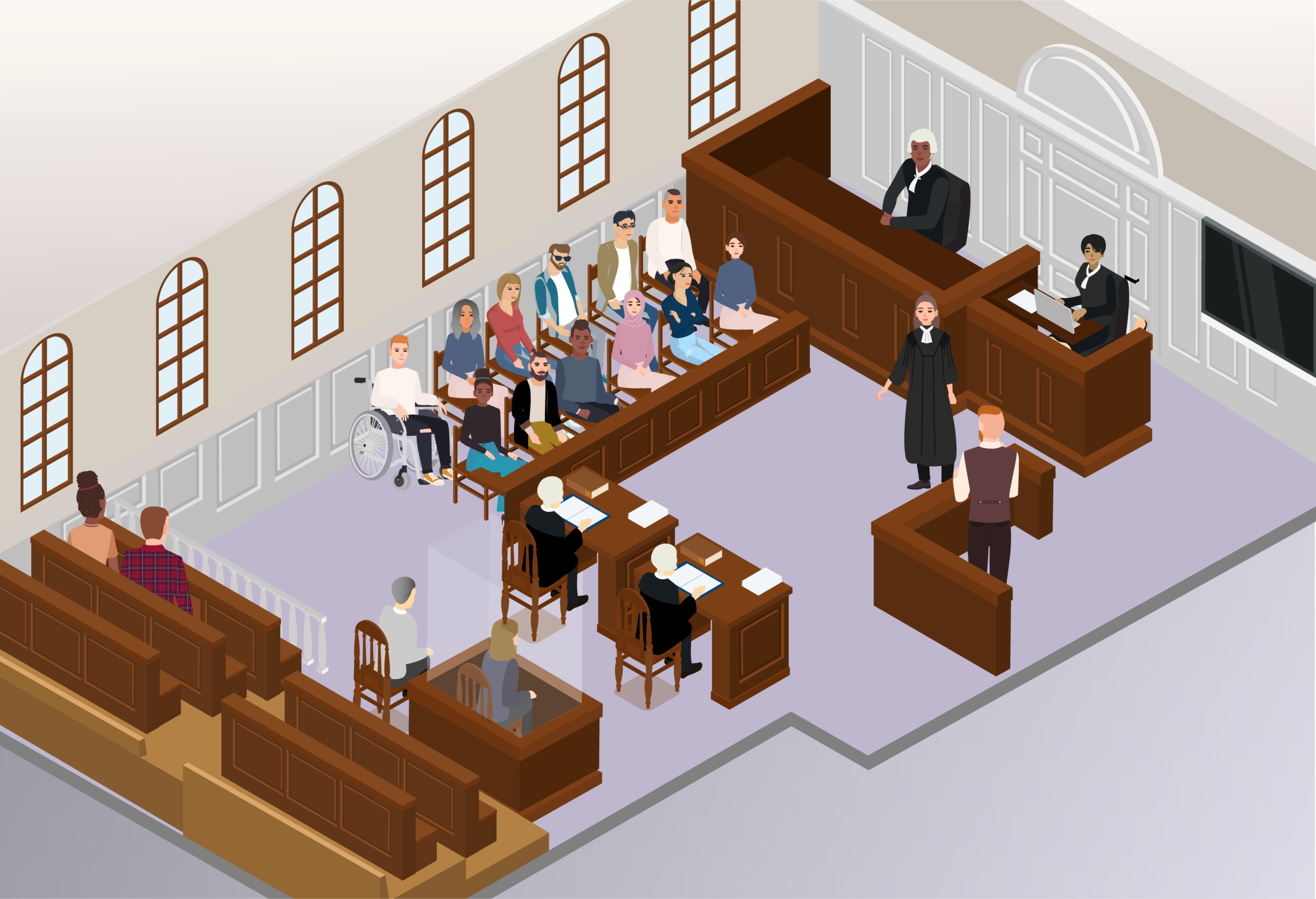
The judge is responsible for overseeing the trial, ruling on points of law and making sure a defendant gets a fair trial. The judge will decide the sentence if a defendant is found, or pleads, guilty. Judges follow sentencing guidelines.
Use the play button below to read aloud.
Jury
The jury decides the outcome of cases in the Crown Court. There are 12 members of the public on a jury.
They listen to all the evidence during a trial, and any direction the judge may give them. They will then decide whether the defendant is guilty. When all the jurors agree that a defendant is guilty or not guilty, it’s known as a ‘unanimous verdict’.
If they cannot all agree, they may be asked by the judge to pass a ‘majority verdict’. This is where at least 10 of them agree. If the jury cannot reach a verdict, it is called a ‘hung jury’, and the judge will discharge the jury.
Use the play button below to read aloud.
Witness
A witness is someone who has seen, heard or knows something important about an event being considered in court. They can be called to give evidence either by the prosecution or the defence.
They will give their evidence and answer questions from the witness stand, by live video link or in other ways such as pre-recorded video evidence. Witnesses are not expected to know everything or remember every detail, just to honestly share what they know in their own words.
Use the play button below to read aloud.
Defendant
A defendant is the person who has been accused of the crime the trial is about. They usually sit in the dock.
A uniformed prison custody officer, or court security officer, may be next to the defendant in the dock.
Use the play button below to read aloud.
Prosecution team
The Crown Prosecution Service (CPS) usually leads the prosecution, and their job is to present the evidence that shows what they believe happened. They aim to prove the defendant is guilty.
The CPS prosecutes most cases in the criminal courts and uses lawyers who are called Crown Prosecutors or Crown Advocates. In the Crown Court, the CPS may prosecute the case through one of its Crown Advocates or instruct a local barrister to prosecute on its behalf.
Use the play button below to read aloud.
Defence team
The defence team represents the defendant in court and advises them on legal matters. The defence team responds to the prosecution’s case to make sure the defendant gets a fair trial.
Use the play button below to read aloud.
Public gallery
Courts in England and Wales are considered public buildings. This means members of the public can attend court to watch trials, and members of the press are normally able to attend to observe and report on trials.
Journalists typically sit in the public gallery. But in some Crown Courts, there may be a designated press bench or media area, often near the prosecution team.
Use the play button below to read aloud.
TV screens
Witnesses’ video-recorded evidence, and video-recorded cross-examination, is played to the court on the TV screens in the courtroom. If a witness is giving evidence by live link, the TV screens display this live video feed to everyone in the courtroom.
Use the play button below to read aloud.
Court clerk
The court clerk helps to ensure court proceedings run smoothly. They prepare the TV screens and laptops used to show evidence in court and for live link video set ups. They read out the formal charges and make notes during the trial. The clerk usually wears a black gown.
Use the play button below to read aloud.
Usher
The court usher supports people who are attending court, such as witnesses and jurors. They prepare the court and make sure everyone is ready and in the right place at the right time. They usually take the oaths of witnesses during the process of swearing in. The usher usually wears a black gown.
Use the play button below to read aloud.